Skip to content

Donato di Camillo

In a five minute break from work, while I was mindlessly scrolling down my Facebook news feed, I saw an image that jolted me and made me stop and stare.

It’s a one eyed man, his mouth wide open revealing broken teeth and he’s staring up above him – in surprise or in fear? Is he looking at  the seagull that’s just flown past or at something unseen and terrible in the heavens? Behind his right shoulder is a brightly coloured seaside funfair. To his left, dark clouds are gathering over the pier and out to sea.

It’s like a scene from a film or the first picture from a novel. Except it’s real and it’s the work of a photographer called Donato di Camillo.

Donato is self taught – upon his release from prison, he began taking photos of the people he saw around him in New York, people on the fringes of society, people who are otherwise unseen or ignored.

Donato says:

“I want [my subjects] to understand that the reason I’m photographing them is because I see something in them that I see in me, or that I think the rest of the world could relate to.”

He is a photographer with a real talent for capturing portraits that reveal their subjects at a particular moment in time – sometimes chaotic, sometimes touching, always unique.

Related Content

Donato di Camillio’s website


My first time doing a live radio interview…

As a producer, I’m used to being on one side of the microphone. But during the course of BBC Music Get Playing, an opportunity presented itself for me to do a live radio interview.

I met Miranda Rae through Sound Women. Miranda presents her own show called The Word on Ujima Radio in Bristol. Her programme goes out live every Friday from 1400 to 1600 and is a wonderfully varied mix of art, culture and music.

The Virtual Orchestra deadline was fast approaching and I was trying to get as many people as possible to upload their videos of themselves playing Bizet’s Toreador Song. Miranda asked me if I’d like to go onto the programme to invite her listeners to join the Virtual Orchestra.

At first, I must confess I was was tempted to ask for a pre-recorded interview but soon decided to go for it.

Miranda has interviewed many people during her career including Massive Attack, Roni Size, Neneh Cherry…and now me.

I really enjoyed my first live radio experience and you can hear the interview here.

And you can follow Miranda on Mixcloud and hear more interviews here.

Useful Links

Ujima Radio

Sound Women

Jeff Mills: The Woman in the Moon Cinemix

Last night, I went on a spellbinding trip to the moon – while staying in South East London.

I was sat inside the lovely old theatre The Coronet, watching Woman in the Moon (Frau im Mond, Fritz Lang’s futuristic silent movie from 1929)  while listening to techno DJ  Jeff Mills live mixing his stunning soundtrack.

It was an incredible fusion of the past, the present and the future. Women in the Moon was produced 40 years before the moon landings, and the rocket launch sequences were eerily prescient. Jeff Mills’ sound track underscored the shifting dynamics between the characters as well as underlining the dangers that lie in the overwhelming love of money.

From January 2017, another beautiful venue will be lost in London. The Coronet has been in the Elephant and Castle since 1879 – but will be disappearing next year  as the developers move in.

While I understand the need for progress, I wish gentrification didn’t so often signify the destroying of history, of buildings that made an area special, the universal conformity that seems to follow inevitably in its wake. Look to your left, there’s your luxury new developments. Look to your right – whether you are in Elephant or Castle or Ealing- there’s your Pret, your Starbucks, your Pizza Express.

Woman in the Moon at the Coronet – a nod towards the future and another ending.


Beckett Blindfolded: All that Fall

‘I’m going to see a play tonight,’ I told my friends. ‘Except I won’t actually see it -I’ll be wearing a blindfold.’

Their response was confused – but inquisitive. ‘Eh? Why are you wearing a blindfold?’

Because I was going to see Out of Joint’s production of All That Fall. This was Beckett’s lush, lyrical radio play that I read at university and had wanted to ‘see’ for years. I loved the rhythm and flow of the words, the story of Mrs Rooney travelling to the station to collect her blind husband as a surprise on his birthday.

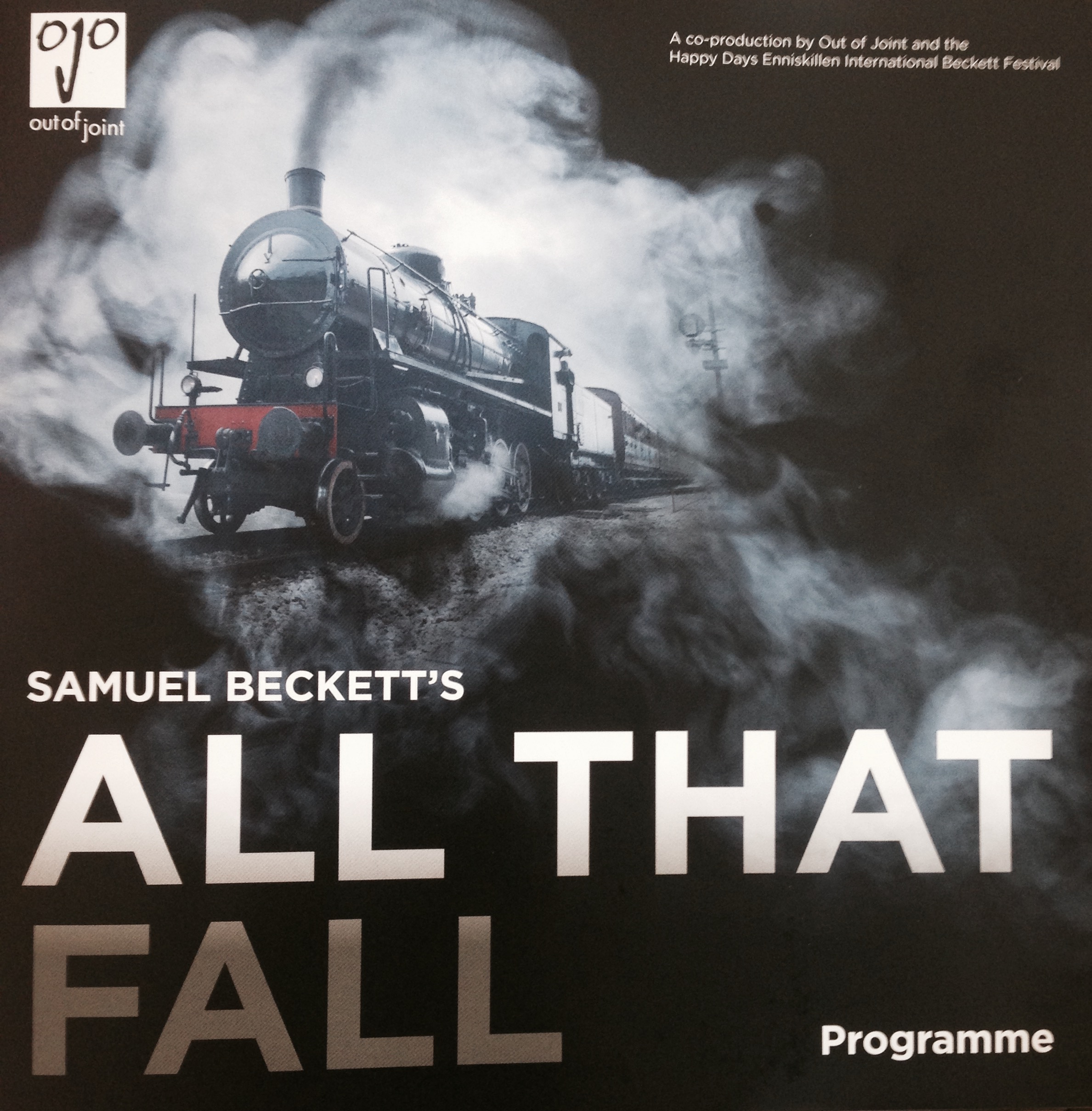
All That Fall - programme cover

Despite being one of Beckett’s more naturalistic plays, All That Fall is not very well known as the playwright was firmly opposed to his radio plays being adapted for the stage or screen. Beckett believed a radio play was ‘for voices not bodies’ and ‘to “act” it is to kill it.’

Theatre company Out of Joint’s answer to this is simple: blindfold the audience.

Stripped of sight, the play is a very intimate, immersive experience. All That Fall takes place in the low lit Victorian brick surroundings of Wilton’s Music Hall. Within a few seconds, I found the music hall was merging with a country Irish road populated with larger than life characters.

Mrs Rooney is a complex woman. She is funny and full of self-pity; she is also determined and loving.  Maddy Rooney will get to the station to collect her husband, no matter what setbacks may befall her on the way.

There are many wonderful 3D sound effects. A bicycle weaving through country lanes, a horse very reluctantly starting to pull its dung cart and a train speeding through the station, so close I could almost feel the wind on my face as it sped by.

The actors move among the audience all the time. Sometimes they are on the opposite side of the auditorium, sometimes they are right next to me, creating long shots and close ups inside my head. This dynamism means each audience member gets a different experience and perhaps an alternative perspective on what did – or didn’t – happen on the train.

Out of Joint has made a great radio play into a wonderful stage production while remaining true to Beckett’s vision of the play. As the director, Max Stafford-Clark says, ‘…there was no vision at all. Beckett’s instruction was that the voices come “as from the void”.’

This aural-only landscape provides both slapstick humour and darkness.  There’s Mrs Rooney the ‘big fat jelly’ being hoisted up into Mr Slocumb’s car. And the train is delayed – for a tragic reason. Go to All That Fall and see what happens in your mind’s eye. Decide how big – or not – Mrs Rooney is – and decide for yourselves whether the very dark end to the play really did occur.

Leap Year – Leap Back to Working Lunch

It’s Monday February 29 2016 – and I have been trying to remember what I was doing last leap year.

Unsurprisingly, I couldn’t remember 4 years ago but I did uncover something I did in November 2001.

Working Lunch

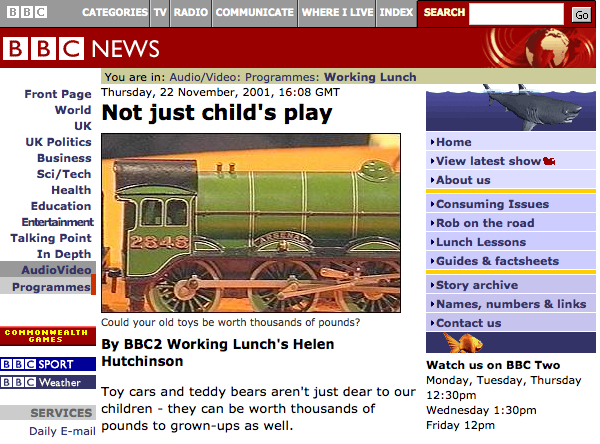
Not just child’s play was an article I wrote for the Working Lunch website off the back of an item I produced on investing in children’s toys.

It’s fascinating seeing how the BBC websites  have developed since. Selecting the BBC News Front Page link catapulted me straight back to 29 February 2016.

Now I wonder where I’ll be four years from now…


The 6 Music Festival and Madonna falling off the stage at The BRITS

February 2016 was a month packed with music.

6 Music Festival

Savages, John Grant and Laura Marling were just some of my personal highlights from the 6 Music Festival in Bristol.

I spent a great weekend working with the web team back in London. I was photo-editing,  deciding which images should be used where on the website – including the single track image, 30 minute set image and the main promotional hero image. I also curated article pages, selecting the best photos which I then used to produce the Highlights article page in Isite2 -for example, Sunday Night’s Best Photos.

Radio 1 

The Monday after the 6 Music Festival, I was in the Pop Hub (which covers Radio 1, 1Xtra, 2, 6 Music and the Asian Network).

I wrote my first article for Radio 1 – One Love at Radio 1 – which included dating advice from A-List celebrities Rebel Wilson, Dakota Johnson and Ryan Reynolds.

On Friday, Ant and Dec were on the Radio 1 Breakfast Show. I listened to the broadcast then selected the most shareable clip. As The BRITS are next Wednesday, I chose Ant and Dec’s memories of The BRITS 2015 – which included missing Madonna falling off the stage. I put Ant and Dec’s clip in the Radio 1 Guests Collection and got it featured on the BBC Homepage on Sunday 21 February.

Ant and Dec Homepage

The Homecoming by Harold Pinter

The Homecoming by Harold Pinter – directed by Jamie Lloyd 

Harold Pinter’s darkly savage drama The Homecoming first hit the London stage in 1965.

50 years on, this unsettling, savagely funny play still has the power to shock and unnerve.

Director Jamie Lloyd’s adaptations of Pinter have been the best I’ve seen – his frenetic directing giving a surreal fast-cut feel to the action while always ensuring Pinter’s words remain the icy heart of the play.

The play opens in total blackness. Suddenly, the stage flares into life with pounding music. Aggressive neon lights outline the edge of the house. A single light bulb dangles from the ceiling. The door bursts open and in strides Lenny (John Simm), the wiry, fast moving middle son of the family. He sits down, shakes open his newspaper and lights a cigarette. The impression is of a  1980s video but the year is 1965 and the place is South London.

The door opens again and in strides macho Max (Ron Cook), the bullying father. He purposefully sits in his chair – the one that nobody else must touch – shakes open his newspaper and lights a cigarette. Father and son begin to talk in short, aggressive bursts.

This warring family of four men live out their days verbally and physically sparring with each other. Max spits out venom at his camp brother Sam (Keith Allen) but Sam uses his knowledge of Max’s wife to wound back in turn. Max turns red and spits, losing control – he is a  bully whose power to hurt is on the wane.

Into this fractured, angry household arrive Gus (Martin Kemp), the eldest son and his wife, Ruth (Gemma Chan).

The cast each inhabit their roles with precise perfection. Flashes of the inner turmoil suffered by each of the characters appear when they think they are alone. Ruth staggers around outside the house, unable to breathe. Lenny tries to smash a clock. Joe repeatedly lashes out at his own reflection in a mirror.

As always with Pinter, the truth lies shimmering somewhere under the surface of the words. It’s left to the audience to insert their own back-stories into the heavy pauses and elliptical exchanges. Max certainly physically abused his sons when they were weaker than him and there are possible hints of past sexual abuse. Now it’s only his brother Sam and Joe the youngest son, the slow-witted boxer, who are on the receiving end of his walking stick.

In the end, it’s Ruth’s homecoming. It becomes gradually apparent that she does not share her husband’s love of US campus life – she feels trapped over there in her role as dutiful wife and stay-at-home mother.  So, she swops one family of males for another, choosing to stay with her husband’s family in London. Pinter makes no judgement on this decision – he only makes it clear that this choice is Ruth’s alone.

The play closes on a final, haunting image of Ruth. She has physically unseated Max – now she is the one sitting in the chair, surrounded by her new family, staring out impassively into the audience. The balance of power is shifting and it’s left to the audience to decide who emerges victorious.


The Sound Women Podcast: Mentoring

This month’s Sound Women Podcast covers everything to do with mentoring – from finding a suitable mentor through to getting the most out of being a mentee.

If mentoring is going to play a part in your life this year, head over to the Sound Women website and listen to the podcast.

The podcast is hosted by Kate Thornton and features the following industry leaders:

  • Helen Boaden (Director of BBC Radio)
  • Fran Plowright (Creative Learning Consultant)
  • Caroline Raphael (ex Radio 4 Commissioner, Editorial Director of Audio Penguin Random House)
  • Sue Ahern (Director of Training, Sound Women and Creative People)


Enjoy the podcast?  Join the conversation @soundwomen #SWPodcast

Samuel Pepys – Plague, Fire, Revolution Exhibition

Samuel Pepys: Plague, Fire, Revolution Exhibition – Greenwich Maritime Museum, 20 November 2015 to 28 March 2016

“But so great a noise, that I could make but little of the Musique; and endeed, it was lost to everybody. But I had so great a list to pisse, that I went out a little while before the King had done all his ceremonies…”  Samuel Pepys’ description of the coronation of King Charles II , April 23, 1661

How many of us have attended a big event with high hopes – whether a coronation or a concert – only to have our view blocked by the crowd, be unable to hear due to people shouting close by and worst of all, realising we need to pay a visit which means we’ve missed the big event it’s all been leading up to….

There are many official descriptions of the coronation of King Charles II, all written with one careful eye on posterity. For me, it’s this one that echoes down the centuries as it provides a unique personal perspective of the kind that’s often lost in the grand sweep of history.

Pepys – the unwitting historian

The joy of Samuel’s diaries lies in this authentic voice. They were written purely for himself rather than for eventual publication and as such they are bawdy, funny, perceptive and moving.

Pepys begun his Diaries on January 1 1660 and continued for 10 years, stopping only when he feared his eyesight was failing – noting that he could have others write his diaries but he feared the lack of privacy that would bring.

The diaries provide a fascinating account of a life lived in the glare of some of the greatest events of the seventeenth century.

Why aren’t the Diaries in the Exhibition?

It may therefore seem strange that the stars of the show are not to be seen in the Exhibition in physical form.  Pepys left them to his old Cambridge college Magdalene in his will and said if the diaries were ever to be removed, then their rivals Trinity were to have them. Hence, visitors to Greenwich Maritime Museum can browse the diaries digitally but not see them in reality.

Plague, Fire, Revolution

The Exhibition  leads us through the key moments of Pepys’ life in turn – from witnessing the beheading of one monarch (Charles I) to the deposing of another (James II, by his daughter Mary and son-in-law William), via the Great Plague of 1665 and the Great Fire of 1666.

There are many grisly historical artifacts  ranging from the blood stained satin gloves worn by Charles I on the scaffold through to the instruments used to remove Pepys’ kidney stone which was nearly the size of a tennis ball and removed without anesthetic…(Pepys was unusual in that he recovered from the operation without complications and resolved to hold a celebration on every anniversary of the operation.)

With over 200 paintings and historical objects and a wonderfully descriptive and amusing guide in Pepys, this exhibition is a fantastic way to experience the tumultuous, violent and epoch defining events that shaped the London streets we walk in today.



1 4 5 6 8